NRMP Stakeholder Conference
Call for Proposals Now Open!
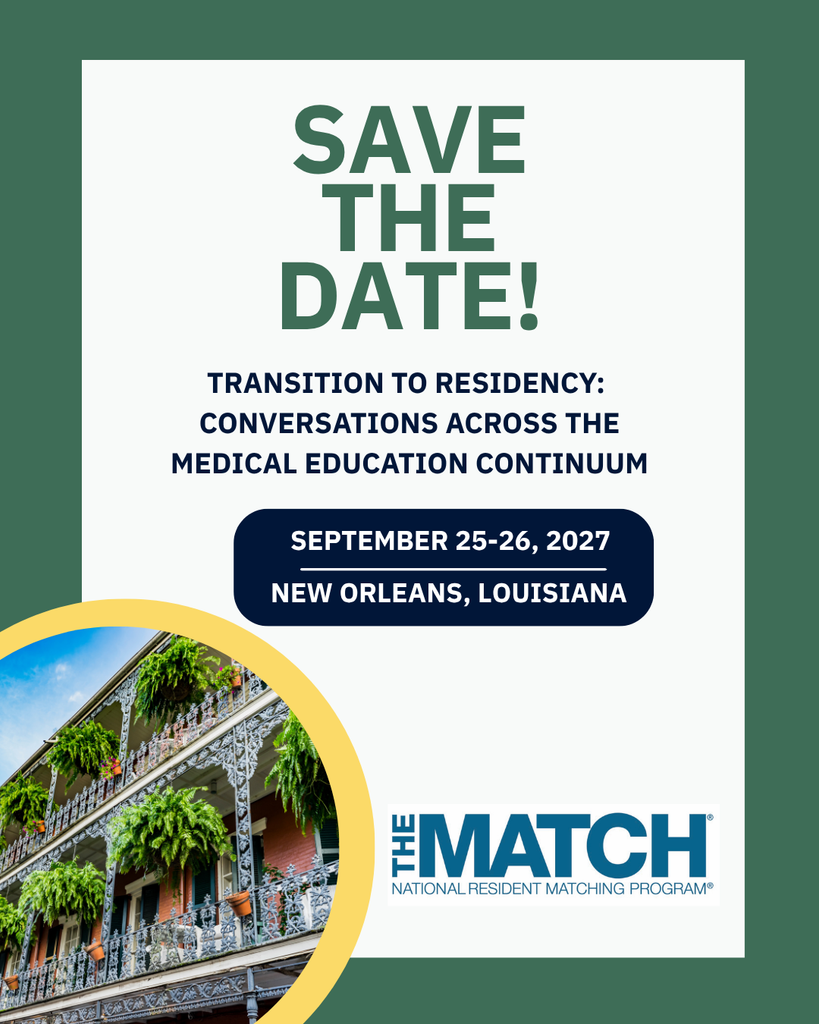
We are hard at work preparing for next year’s Transition to Residency conference, and to that end, we are pleased to announce that abstract proposals are now being accepted! We invite the community to consider submissions that focus on
- Physician Workforce (e.g., data, advising)
- Innovation in transition to residency, fellowship, or practice
- Technology (e.g., resources development, utilization of AI) in UME and GME
- Readiness for residency
- Learner, faculty wellness
- Health policy (e.g., GME reform)
- Access to Care
- Outcomes-Driven Collaboration and Shared Learning
Abstract proposals will be open through December 15. We hope you will share your work and plan to join us when we reconvene the community in New Orleans, Louisiana!
About the NRMP Transition to Residency Conference
The NRMP’s annual stakeholder conference, Transition to Residency: Conversations Across the Medical Education Continuum, was born from an idea in 2014 that a place should exist where both UME and GME professionals could network and discuss the transition to residency. NRMP leadership realized The Match was uniquely qualified to create an environment where stakeholders from both sides of the aisle could share and learn from each other.
Throughout its 10-year tenure, the NRMP’s Transition to Residency meeting has engaged thoughtful plenary speakers and curated meeting content around key themes including:
Innovation in the Transition
The focus and function of undergraduate and graduate medical education has changed significantly over the past 5–10 years. As a community we must stay increasingly attuned to how curriculum, clerkships, residency application, and recruitment must progress and advance to promote the success and well-being of young physicians during and beyond their training.
Technology
The role of technology in health care is constantly evolving and is fundamentally changing the face of medical education, assessment, and residency recruitment. How technology interacts with, even enhances education, training, and practice are critical concepts to understand.
Wellness
The rigors of medical education and residency training can take a toll on the physical, mental, and emotional well-being of learners. Efforts to understand the scale and scope of student and trainee stress and better recognize the collective realities and dangers of physician burnout are a priority.
Advocacy
Shifts in the political landscape leave indelible marks on medical education. As such, it’s important to maintain awareness of legislative directives that impact and inform the efforts of medical educators to train young physicians and prepare them to meet the growing and evolving needs of patient populations and communities across the nation.